AP Art History
Showing posts with label AP Art History. Show all posts

AP Art History: San Vitale-- #51

Monday, December 26, 2022


Basilica de San Vitale


Bio of the work:

Title: San Vitale
Date: 526-547 CE- Byzantine
Medium: brick, marble, and stone veneer
Location: Ravenna, Italy

Analysis:

    This lovely church, already started by the Goths previously there, is centrally planned with a specific apse and was finished under rule of Justinian. Ironically, although Justinian never visited the church or Ravenna, he and his wife are both depicted in ornate mosaics bordering apse. The true apse mosaic depicts Jesus sitting on a throne flanked by angles, handing a saint a crown, and accepting a small version of the church from the bishop. Justinian is shown just below Jesus, wearing the same robe, surrounded by 12 followers (signifying perhaps the disciples), and holding a loaf of bread (signifying prosperity or maybe the miracles of Jesus). The plan of San Vitale is central with the addition of an apse, a mixture that melds the awe of a central plan but the religious focus of an apse. 
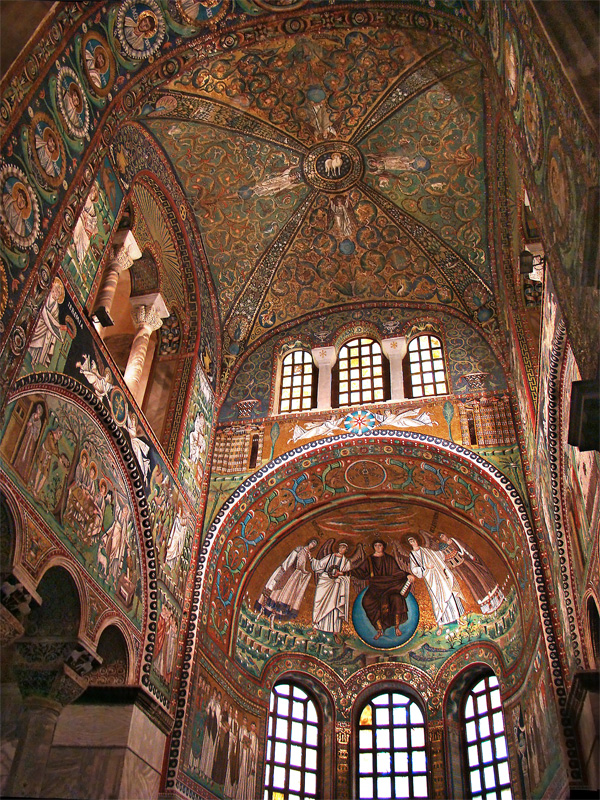


Theodora Mosaic


Justinian Mosaic


Apse Mosaic


AP Tip!!-- The AP loves works such as this because it is a mixture of cultures, a beginning of a style (the Byzantine: with mosaic and pioneering of freedom from Greco-Roman realism), and a wonderful comparison piece to other churches! So it is in your best interest to know it well!!


AP Art History: Global Pre-History Overview

Saturday, October 1, 2022

 Welcome to the first of many time period roundups for AP Art History!

GLOBAL PREHISTORY: 30,000-500 BCE

    The 11 works within this content area are split between Paleolithic (old stone age) and Neolithic (new stone age). Below are works from a large section of the world, ranging from cave paintings, the infamous Stonehenge, and multiple interesting sculptures. 


The Apollo 11 Stones

Date: 25,500-25,300 BCE 
Medium: Charcoal on stone
Period: Prehistoric

    This artifact was found by German archeologists in 1969 in Nambia. The archeologists were listening to the radio footage of the Apollo 11 mission when excavating. These two fragments of stones were found 3 years apart, then joined after the second was located. The figure is added to the stone with charcoal. 


The Great Hall of the Bulls

Date: 15,000-13,000 BCE 
Medium: Rock painting
Period: Prehistoric

    Located in the intricate caves of Lascaux, these intricate paintings depict not only bulls but also numerous animals layered over each other. This layering indicates that this area was used over time and multiple generations. The height and overall scale of these paintings would have been extremely difficult to paint, needing some kind of scaffolding. These animals are all shown in 'twisted perspective', meaning that their bodies are shown in profile but the horns are shown frontally. 

Camelid Sacrum

Date: 14,000-7,000 BCE
Medium: Bone
Period: Prehistoric

    Created from the sacrum or tailbone of an alpaca related animal, this object is very perplexing. Found in the Valley of Mexico, it is deliberately sculpted and smoothed. Like with all objects created before writing, it is impossible to truly know the reason and significance with which this was sculpted. Many believe it later related to Mayan Canine gods/goddesses. 


Running Horned Woman

Date: 6000-4000 BCE
Medium: Pigment on Rock
Period: Neolithic

    First, it is important to note that the above image is the restored version of this painting. I encourage you to do some research on what the non-reconstructed version is. 
    Found in the Tassili region of Algeria, situated in the Sahara Desert, this rock painting is very interesting. Once again, twisted perspective is used in not only the figure in the foreground but also all of the other characters in the background. The central figure is a very intricate and confusing image, with a horned headdress, traditional dress, and maybe some traditional tattooing. Many believe that she may be a goddess, due to the possible rain cloud near her headdress. 


Beaker with Ibex Motifs

Date: 4200-3500 BCE
Medium: Painted Terra Cotta
Period: Neolithic

    This piece of pottery's most distinctive characteristics are the three registers, all filled with highly stylized animals. The most noticeable register includes an ibex or mountain goat with very decorative horns. All three registers shift these animals into geometric shapes, making this object not only interesting from an archeological perspective but also from an artistic one. The other two registers include a breed of dog and a bird. 


Anthropomorphic Stele

Date: 4th millennium BCE
Medium: Sandstone
Period: Neolithic

    This near-human, low relief sculpture is thought to have perhaps been a funerary marker. The double dagger on the waistband was very characteristic of this period. Over sixty-five of these steles were found. A stele is a singular, large piece of stone or wood, engraved in relief with an image or text of some kind. 


Jade Cong

Date: 3300-2200 BCE
Medium: Jade
Period: Neolithic

    Created in Neolithic China, there were hundreds of these congs found in graves along with bi (disks made from jade). Their purpose is unknown, but archeologists know that they must have been a fairly long standing custom due to their multitude. Jade is a notoriously hard material and during Song China, machines to cut this material had not been created. This means that all sculping was done by abrasion. 


The Ambum Stone

Date: 1500 BCE
Medium: Greywacke
Period: Neolithic

    While being used by Natives of Papua as a ritual object, New Guinea, this sculpture was taken from its place of origin. Its original purpose is again unknown, but many think that perhaps it was used as a mortar and pestle by holding the nose and grinding with the bottom.  


Tlatilco Female Figurine

Date: 1200-900 BCE
Medium: Ceramic
Period: Neolithic

    Found in large quantities in a burial setting, this figure is one of many but has a very interesting defining factor: the two faces. The Tlatilco village was a pre-Columbian culture who settled in the Valley of Mexico. It was the setting of the Aztec Empire 2000 years later. The coloring of this sculpture, hair details, hands, and feet set it apart from its counterparts. As a collective, these figures pose the same question as many pieces of Prehistory art: What were the religious beliefs of this culture? Many scholars point to this sculpture as an emphasis in duality, light and dark, and good and evil. 


Terra Cotta Fragment 

Date: 1000 BCE
Medium: Terra cotta
Period: Neolithic 

    This fragment comes from the Lapita culture in the Philippines. Pacific island culture such as this Filipino one are famous for their symmetric, stylized tattoos. This piece of terra cotta is believed to have been part of a very large design. It includes an anthropomorphic face, geometry, and cross hatching. 


Stonehenge

Date: 2500-1600 BCE
Medium: Sandstone
Period: Neolithic


AP Art History: Monticello-- #102

Tuesday, June 21, 2022


Monticello: Home of Thomas Jefferson


Bio of the work:

Title: Monticello
Date: 1768-1809
Medium: brick, glass, stone, wood
Location: Charlottesville, Virginia, USA

Analysis:
    
    Author of the Declaration of Independence, Founder of the University of Virginia, and 3rd President of the United States of America, Thomas Jefferson was also the architect of Monticello. Meaning 'little mountain' in Italian, Monticello is located at the top of a picturesque summit in the hills of Virginia. In designing his Virginian home, Jefferson created what is now known as Jeffersonian architecture. Heavily based in the work of Andrea Palladio and his Four Books of Architecture, Jeffersonian architecture is Neo-Palladian and Neo-Classical, meaning it is influenced by the classical architecture of Rome and Greece. This style is also reminiscent of Jefferson's time spent in France, including large domes he incorporated into many buildings (Monticello, UVA's rotunda). During this period in American architecture, Greek Revival was being popularized. 

Sources: the lovely tour of the Monticello I took today!


AP Art History: The Colosseum--#44

Friday, June 10, 2022


The Colosseum or Flavian Amphitheatre


Bio of Work:

Title: The Colosseum or Flavian Amphitheatre
Date: 80 AD
Medium: Travertine limestone, tuff, brick, concrete
Museum: East Roman Forum, Rome, Italy

Analysis:
     The Colosseum was commissioned by Emperor Vespasian as a public space for the Roman people around 70 AD in hopes to somewhat revitalize Rome. Vespasian's son, Emperor Titus, opened the Colosseum to the public in 80 AD. This structure is extremely complex with numerous entrances based on class and a capacity of 50,000. To celebrate this grand opening, Titus declared 100 days of games at the Colosseum. These 'games' included dramas, infamous gladiator battles, reenacted 'sea' battles, and wild animal hunting. The three levels of the Colosseum all follow a different order. The first one is Tuscan, second Doric, and lastly Corinthian. Seating was also leveled, based on citizenship status. Upper class visitors would sit furthest down, mean the further away from the action, the lower the status. 


Sources: 
     https://www.thecolosseum.org/architecture/
     https://education.nationalgeographic.org/resource/colosseum

AP Art History: Last Supper-- #73

Thursday, May 26, 2022


Bio of the work:
Title: Last Supper
Date:1497 
Medium: Oil and Tempura
Location: Santa Maria delle Grazie, Milan, Italy

Analysis: 
    One of the most iconic and famous works of Christian art, The Last Supper was painted by Leonardo da Vinci directly on an exterior refectory, eating room, wall of the Church of Santa Maria delle Grazie. It depicts Jesus and his disciples in a climactic scene of Jesus's last meal before his crucifixion. It was commissioned by Ludovico Sforza, duke of Milan (Garnder, Kleiner 629). On August 26, 1943, the church and monastery were hit with a bomb, damaging the building and putting The Last Supper in serious danger. This air raid was said to have been from Allied forces, and it damaged multiple other important sites including the ruins of Pompeii (United Press 4). Multiple walls were blown up as well as large portions of the roof. In the refectory, The Last Supper thankfully suffered little damage, but a wall the roof were damaged, so the painting was unprotected during the rebuilding of the structure. However, The Last Supper itself is in much poorer condition today than the church and monastery itself. In experimentation, Leonardo mixed oil and tempura paint to create a different texture to the painting, also painting on a dry surface instead of the traditional wet. Due to Leonardo's painting style, Milan's extremely humid and hot climate, and past failed restorative practice, the painting is flaking and is in constant need of repair ("Church and Dominican" UNESCO).


Bruschi, Arnaldo. "Donato Bramante." Britannica School, Encyclopædia Britannica, 2022, school.eb.com/levels/high/article/Donato-Bramante/16193. Accessed 26 Apr. 2022.
"Church and Dominican Convent of Santa Maria delle Grazie with 'The Last Supper' by Leonardo da Vinci." UNESCO World Heritage Centre, 2022, whc.unesco.org/en/list/93. Accessed 26 Apr. 2022.
"Church and Dominican Convent of Santa Maria delle Grazie with (UNESCO/NHK)." YouTube, uploaded by UNESCO, www.youtube.com/watch?v=tFMULmxfnXQ. Accessed 26 Apr. 2022.
King, Ross. Leonardo and the Last Supper. Paperback edition ed., New York City, Bloomsbury, 2013.
Kleiner, Fred S., and Helen Gardner. Gardner's Art through the Ages: A Global History. Fifteenth edition, Student edition ed., Boston, Cengage Learning, 2016.
"Leonardo Da Vinci." Arts and Humanities through the Eras, edited by Edward I. Bleiberg et al., vol. 4, Gale, 2005, pp. 424-25. Gale eBooks, link.gale.com/apps/doc/CX3427400775/GVRL?u=tel_k_harpeth&sid=bookmark-GVRL&xid=36befb31. Accessed 29 Apr. 2022.
"Santa Maria delle Grazie." Cenavolo Vinciano, Piazza di Santa Maria delle Grazie, cenacolovinciano.org/en/story/saint-maria-delle-grazie/. Accessed 4 May 2022.
"Santa Maria delle Grazie with The Last Supper." Italia, National Tourist Board, 2021, www.italia.it/en/santa-maria-delle-grazie-with-the-last-supper. Accessed 26 Apr. 2022.
United Press. "Leonardo's 'Last Supper' Intact amid Raid Debris." New York Times, 27 Aug. 1943, p. 4, timesmachine.nytimes.com/timesmachine/1943/08/27/88563617.html?pageNumber=4.

AP Art History: The Two Fridas -- #140

Saturday, April 23, 2022


   The Two Fridas by Frida Kahlo


Bio of the work:
Title: The Two Fridas
Date: 1939
Medium: oil on canvas
Location: Museo de Arte Moderno, Mexico City

Analysis:
    Frida Kahlo is the most famous artist of the Mexican Revolution along with her husband, Diego Rivera. The Mexican Revolution and the art movement that followed was centered around native Mexican people reconnecting with their Indigenous roots from pre-Spanish colonization. The Two Fridas depicts two separate versions of Kahlo herself. Kahlo's father was German and her mother Indigenous. She depicts herself in traditional Mexican clothing and a Eurocentric dress. These two conflicting parts are tied together by their physical hearts. Much of Frida Kahlo's work deals with her identity as native-Mexican and German, as well as the balance between the two. 


AP Art History: Vietnam Veterans Memorial- #225

Friday, April 8, 2022


Vietnam Veterans Memorial 


Bio of the work:
Title: Vietnam Veterans Memorial 
Date: 1982
Medium: Carved Granite
Location: The National Mall in Washington D.C., USA

Analysis:
    Maya Lin, the artist, designed this work as an assignment in her architecture class at Yale. Her design won over even her professor, gaining her lots of backlash. The reflective quality of the granite allows for the lists of veterans carved into the stone to be read while the viewer sees his or her reflection. The experience created at the Maya Lin is incredibly powerful, pensive, and solemn, allowing the viewers to consider themselves within the history and space. 

Click here for the post about Maya Lin, the artist behind this stunning work

AP Art History: Composition with Red, Blue, and Yellow-- #136

Sunday, January 23, 2022


Composition with Red, Blue, and Yellow


Bio of the work: 
Title: Composition with Red, Blue, and Yellow
Date: 1929
Medium: Oil on canvas
Museum: The Kunsthaus Zürich 

Analysis:

    Mondrian was an abstract painter and claimed to be what is called a Neo-Plastist. Being inspired by the cubist reduction of forms to their simplest, Mondrian experimented with blocks of color during the 1920s and 30s. Instead of using fluid forms like his contemporaries, Mondrian composed his paintings of structured, but expressive forms. His style quickly diverged into "De Stijl" or "the style" which was adopted by the Bauhaus in Germany. Mondrian tries to express an impression and a feeling through his structured compositions. 

Sources: 
    https://www.khanacademy.org/humanities/ap-art-history/later-europe-and-americas/modernity-ap/a/mondrian-composition


Do you have a specific AP Art History work you need help with? Comment, email, or DM!


AP Art History: David-- #69

Saturday, November 27, 2021


David by Donatello 


Bio of the work: 
Title: David
Date: circa 1440
Medium: Bronze
Museum: Museo Nazionale de Bargello, Florence


Analysis: 
    A master work from the Italian Renaissance (click to learn about this movement), David by Donatello was commissioned by the Medici family (click the link for more about their role in the Renaissance). It is a bronze statue depicting the biblical scene of David after defeating the giant, Goliath. At David's feet lies his head, and David is holding the sword that was used to cut off Goliath's head after he slayed Goliath with the stones. Donatello's depiction of David was unique due to his showing him as the young boy that he was in the Bible. Earlier depictions showed David as his much older self as the king. By depicting him as an immature teen boy, Donatello dramatized the sheer miracle from the Bible. 


"Donatello's David." Italian Renaissance, www.italianrenaissance.org/donatellos-david/. Accessed 27 November 2021.

AP Art History: The Birth of Venus-- #72

Wednesday, October 20, 2021


 The Birth of Venus by Sandro Botticelli


    Arguably the most iconic Renaissance masterpiece, Botticelli's Birth of Venus depicts the ancient mythological scene, but rather than a true birth, Botticelli's Venus majestically rises from the seafoam in a scallop shell. 

Bio of the work: 
Title: The Birth of Venus
Date: 1483 - 1485
Medium: Tempura on canvas
Museum: Uffitzi Gallery, Florence, Italy 

Analysis
   At this point in this point in the Renaissance, artists were mostly working on wood panels, making Botticelli's choice of canvas unusual and progressive.  According to Greek mythology, the goddess Venus was born of the sea on to the island of Cyprus. The bystanders include Zephyrus, the god of the wind and breeze, holding a nymph, Chloris, and the goddess Hora waiting to give Venus a lavish, rose cloak.  While totally nude, Venus modestly covers herself with her own hair. Click this link to learn about the Renaissance as a whole including Botticelli and his contemporaries. 


Sources: 

https://artsandculture.google.com/asset/the-birth-of-venus-sandro-botticelli/MQEeq50LABEBVg?hl=en

http://www.italianrenaissance.org/botticelli-birth-of-venus/

AP Art History: Stonehenge-- #8

Sunday, August 29, 2021


 Stonehenge

    An Neolithic wonder to so many or so long, Stonehenge is in Avenbury, Wiltshire, England and is a very popular tourist location. So amid many cheesey- clickbait videos--What is it? A market place? Place of worship? Home? 


Bio of the work: 

Date: 2500-1600 BC
Title: Stonehenge
Medium: Indigenous bluestone and sarsen
Location: Wiltshire, England

Analysis: 
    
     Aside from being one of the most recognizable and famous Neolithic archeological sites, Stonehenge was very revolutionary, showing many signs of early technology. Many stones were fit together in joints and the stones were brought long distances. While there have been many theories around the purpose of Neolithic peoples building this monument, the most accepted one is that of a temple, as the monument is aligned with the sun. Stonehenge is also some of the earliest examples of trilithons, 3 stones together in a post and lintel fashion.  


Citations: 
https://www.english-heritage.org.uk/visit/places/stonehenge/history-and-stories/history/description/

AP Art History: The Calling of Saint Mathew-- #85

Thursday, August 5, 2021


The Calling of Saint Mathew by Caravaggio 


       Caravaggio's The Calling of Saint Mathew is a wonderful example of a Baroque piece. Caravaggio includes tenebrism, use of light in a very dramatic and strategic way, (click to learn more about it) and a biblical subject matter. 


Bio of the work: 

Title: The Calling of Saint Mathew
Date: 1599-1600
Medium: oil on canvas
Museum: Contarelli chapel, San Luigi dei Francesci, Rome

Analysis: 

    In Caravaggio's biblical scene, Jesus calls Mathew to become an apostle. At this moment, Jesus points his finger a Mathew, emphasized by the strong stream of light flooding in. Saint Mathew points to himself in confusion. Caravaggio depicts Mathew's spiritual awakening through this Baroque masterpiece. Click here to learn more about the Baroque.  

AP Art History: White Temple and Ziggurat-- #12

Thursday, July 22, 2021


White Temple and Ziggurat

    This ancient site is in Uruk, modern Warka in Iraq. The first image is a re-imagination of what archeologist suspect the temple looked like originally. Click here for what a ziggurat is!!

Bio of the work: 

Title: White Temple and Ziggurat 
Date: 3500-3000 BCE
Medium: Mud bricks
Location: Uruk, modern Warka, Iraq

Analysis: 

    The Sumerian city state of Uruk was, like Sumer at large, a theocracy, meaning the leader was also a religious figure or god. Because of the large ziggurat, the temple has no direct access and only the king or religious leaders would be allowed on the platform. The White Temple is a prime example of bent access, meaning that the corners are on the cardinal directions. Due to bent-access and the large ziggurat, while a ceremony was taking place, the figures could be seen from the city below circling the temple. Many other ancient temples and ziggurats, especially Mesopotamian ones, were to the sky god, Anu. 


AP Art History: The Tête à Tête, from Marriage a la Mode -- #98

Monday, July 12, 2021


The Tête à Tête, from Marriage a la Mode by William Hogarth


    William Hogarth's The Tête à Tête, from Marriage a la Mode series is a very interesting and detail dense piece of art. The lavish interior scene is simple too much for the viewer's eye to take in all at once, leaving them studying it for minutes. 


Bio of the work: 

Title: The Tête à Tête, from Marriage a la Mode series 
Date: 1743
Medium: oil on canvas
Museum: National Gallery- London

Analysis: 

    Hogarth was known for narrative scenes, mostly becoming series such as Marriage a la Mode. Marriage a la Mode is a series of six works, and The Tête à Tête is only one. Much like Fragonard's The Swing, Hogarth mocks English aristocracy and does so by presenting it in a highly satirical way. Every figure in Hogarth's masterpiece is expressing an emotion, and they are all different. Hogarth tells a story with his series. The fathers of the two partners were looking to better their names by climbing the ranks of society. These two figures were in an arranged marriage, thus mocking the ineffective and fruitless marriage deals of the English high class. 


https://www.nationalgallery.org.uk/paintings/william-hogarth-marriage-a-la-mode-2-the-tete-a-tete

AP Art History: Narcissus Garden-- #148

Thursday, June 17, 2021


Narcissus Garden by Yayoi Kusama 

    Yayoi Kusama's Narcissus Garden is an installation work of art (click to learn more).  Originally made of 1,500 plastic silver globes on the lawn outside of the Venice Biennale, a very famous exhibition to which she was not invited. 

Bio of the work: 

Title: Narcissus Garden
Date: 1966
Medium: mirrored, mass-produced balls
Location: various; including Central Park, NYC, and Bernardo de Mello Paz’s Instituto Inhotim

Analysis: 
    
    Kusama stood amongst the 1,500 mirrored balls with a sign reading "Your Narcissism For Sale". These spheres reflected everything--  every passerby, the surrounding architecture, the artist herself, etc. Kusama's genius was brought through when she began selling the spheres, thus proving the point that her sign pointed out. The people were buying a reflection of themselves. 


AP Art History: The Standard of Ur-- #16

Monday, June 14, 2021


Standard of Ur


    This Ancient Mesopotamian work of art is still somewhat of a wonder to archeologists. A two sided, wooden box of sorts, the Standard of Ur is thought to have been a flag, placed on a pole. The two sides depict war and peace with many little figures on both.  

 Bio of the Work: 

Title: Standard of Ur
Date: ~ 2600-2400 BCE
Medium: Wood with lapis lazuli, shell, and red limestone
Museum: The British Museum in London


Analysis:

    The Standard of Ur 's two sides depict Sumerian life in war and peace. The 'war' side of the standard has one of the earliest representations of an army, including chariots, swords, captives, and fatalities of the violence. In contrast with the other, the 'peace' side includes more of daily life. This side has three levels, and some people believe these levels to be the ranks of society. The uppermost level depicts a feast and a clear figure head who is even larger that the rest, braking out of the frame, showing art's hierarchy of scale. The other two show laborers working. Many archeologists believe that this was a flag of sorts to be put on a pole and shown out to the city. 

AP Art History: Winged Victory of Samothrace -- #37

Wednesday, June 9, 2021


 Winged Victory of Samothrace

    Famously situated atop the staircase landing in the Louvre Museum in Paris, the Winged Victory of Samothrace is one of (if not the) most well known Hellenistic sculptures. 

Bio of the work: 

Title: Winged Victory of Samothrace
Date: ~ c. 190 BCE
Medium: Marble
Museum: The Louvre Museum, Paris

Analysis: 

    Winged Victory of Samothrace portrays Nike, the Greek goddess of victory, in contrapposto (click to learn about this term). The sculpture was the attached to the bow of a ship. The wet drapery clings to her elegant yet powerful figure. Unfortunately, Nike's head nor her arms were recovered in the original discover or by the archeologists upon return to Samothrace. This sculpture was most likely created in commemoration for a victory in a ship battle c. ~190 BCE. 

Sources: 
https://www.louvre.fr/en/explore/the-palace/a-stairway-to-victory
AP Art History Guide-- Barrons's 
    

AP Art History: Fountain (second version) -- #144

Tuesday, June 8, 2021


Fountain (second version) by Marcel Duchamp

    Marcel Duchamp shocked the world when he exhibited this work. Fountain is a mass produced urinal that he scribbled a signature of sorts, considering that his name is not R. Mutt, and sent it to exhibition. 

Bio of the work: 

Title: Fountain
Date: 1917
Medium: Porcelain
Museum: Unknown

Analysis:

    Marcel Duchamp's art was very controversial and for good reason. Duchamp was of the belief that anything could be art if it fit a few criteria. For example, the artist's intention for the work and a signature. Duchamp exemplified these criteria in his work, Fountain. While he did sign the work, he did not use his own name. Duchamp redefined art for many people through this work!

Sources: 
"Modern Art" by Taschen 

AP Art History: Hunters in the Snow (Winter) -- #83

Monday, June 7, 2021


Hunters in the Snow (Winter) by Pieter Bruegel the Elder


    Pieter Bruegel the Elder (click to learn more in the Zooming In on him) was an important player in and precursor to the Northern Renaissance. He painted everyday scenes and domestic life. Hunters in the Snow is only one in a series of six seasonal paintings.  

Bio of the Work: 

Title: Hunters in the Snow (Winter)
Date: 1565
Medium: Oil paint on wood
Museum: Kunsthistorisches Museum in Vienna, Austria

Analysis: 

Pieter Bruegel tried to convey the emotion and actions of the winter and cold through many elements in this painting. Many civilians are skating on the ice in the distance, and a few women are tending a fire to the left of the painting. The main focus of this work is the group of hunters, escorted by dogs that are seemingly exhausted by the cold. While the snow overlays the entire landscape, there is nothing dead about Pieter Bruegel's painting. 

Sources: 
https://artsandculture.google.com/asset/hunters-in-the-snow-winter-pieter-bruegel-the-elder/WgFmzFNNN74nUg?hl=en
https://www.khm.at/objektdb/detail/327/

AP Art History: The Swing (AFTER Fragonard)-- #244

Saturday, June 5, 2021


The Swing (After Fragonard) by Yinka Shonibare 

    This work may seem familiar due to the Rococo masterpiece The Swing by Fragonard  (click to learn more), and it is! Yinka Shonibare's sculpture is based off of the original, but with some noticeable modifications. For example, the headless figure, a nod to the French Revolution that was to come after the original time period. 

Bio of Work:

Title: The Swing (After Fragonard)
Date: 2001
Medium: Mixed Media Installation- including cotton fabric, rope, oak, etc.
Museum: Tate, London 


Analysis

Yinka Shonibare's figure in The Swing (After Fragonard) is headless, the artist's emphasis on the terror that was to come after Fragonard's original piece, seemingly due to the French Revolutionary guillotine. His work is also missing the two peering men, and the audience fills this gap. In contrast with Fragonard's original figure's silk and lace garments, this figure is wearing African printed textiles, a nod to anti colonial beliefs. Shonibare dresses his figure in African printed Dutch wax cotton. Indonesian batik textile techniques were appropriated by the Dutch, while the English tried to copy this, making merely a fake. Though the Dutch did not care for the imitation fabric, African peoples loved it and adopted the textile. Although the original, Rococo art was a lavish scene of pleasure, times and circumstances have changed, emphasized by Shonibare's work. 


Sources: AP Art History Guide-- Barron's, and https://www.tate.org.uk/art/artworks/shonibare-the-swing-after-fragonard-t07952

© Art History: On Display • Theme by Maira G.