Art History Terms to Know
Archeology: the study of early history through excavation ad artifacts
It is due to archeologists that the modern world has knowledge of a past one. Most archeologists work in excavation and unearthing artifacts, to gain an understanding of the past. Archeology encompasses more than just prehistoric or ancient history, but goes even further into the modern era.
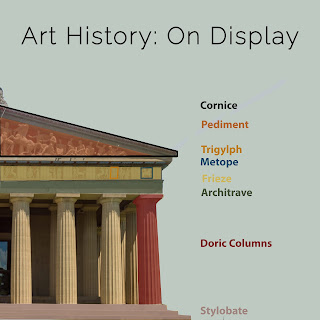
As shown above, the facades of Greek classical monuments have many elements! These are certainly not all of the elements, but many of these are commonly used in art history classes and discussions.
- Cornice: includes pediment and surrounding decorations; the true triangle shape of the facade
- Pediment: usually relief decorated triangle shape on the inside of the cornice
- Frieze: strip of alternating relief stone on all sides of monument; made up of metopes and triglyphs
- Metope: small relief squares within the frieze
- Triglyph: three small, vertical grooves between metopes in the frieze
- Architrave: thin strip of stone below the frieze
- Doric Columns: the most simple of the Greek columns- no base and a small round top
- Stylobate: large set of steps, forming the foundation of the temple
As always, please feel free to DM, comment, or email any questions!
The subject of Greek mythology is millennia in art and many other media. Knowing these figures and their symbology can make understanding and viewing art much more meaningful.
While Greek gods, goddesses, and their myths are very complex, they can be split and simplified down. For example, the 12 'main' gods and goddesses are known as the Olympians, named for their home on Mount Olympus. While the Olympians are important, according to myth, they were not the first. The first gods being Uranus, the original sky god, Gaia, his wife and the personification of the earth. Gaia had many children by Uranus, but the most notable being Kronos. Kronos went on to marry Rhea (his sister) and have many children including Zeus and other brothers and sisters. The Olympians include:
- Zeus: the Chief among all gods (he came to this position by drawing lots with his brothers)
- always depicted with beard
- sometimes with a thunderbolt
- Roman name- Jupiter
- Poseidon: the god of the sea
- Roman name- Neptune
- Hera: goddess of women, childbirth, family, and marriage
- also the wife of Zeus, making her the Queen of gods
- Roman name- Juno
- Demeter: the goddess of agriculture and the harvest
- Roman name- Ceres
- Athena: the goddess of war strategy and wisdom
- the patron god of Athens
- Roman name- Minerva
- Aphrodite: the goddess of love, beauty, and passion
- Roman name- Venus
- Apollo: the god of music and poetry
- depicted with the lyre
- twin to Artemis
- Roman name- Apollo
- Artemis: goddess of the hunt, animals, and the wilderness
- twin to Apollo
- depicted with bow and wild animals
- Roman name- Diana
- Ares: the god of warfare, bloodshed, and violence
- Roman name- Mars
- Hephaistos: the god of blacksmithing and metalworking
- Roman name- Vulcan
- depicted with short tunic and axe
- Dionysus: the god of wine
- Roman name- Bacchus
- depicted with a wreath or vines
- Hermes: the messenger god
- depicted with winged shoes
- broad-rimmed hat
- caduceus- special staff
- Roman name- Mercury
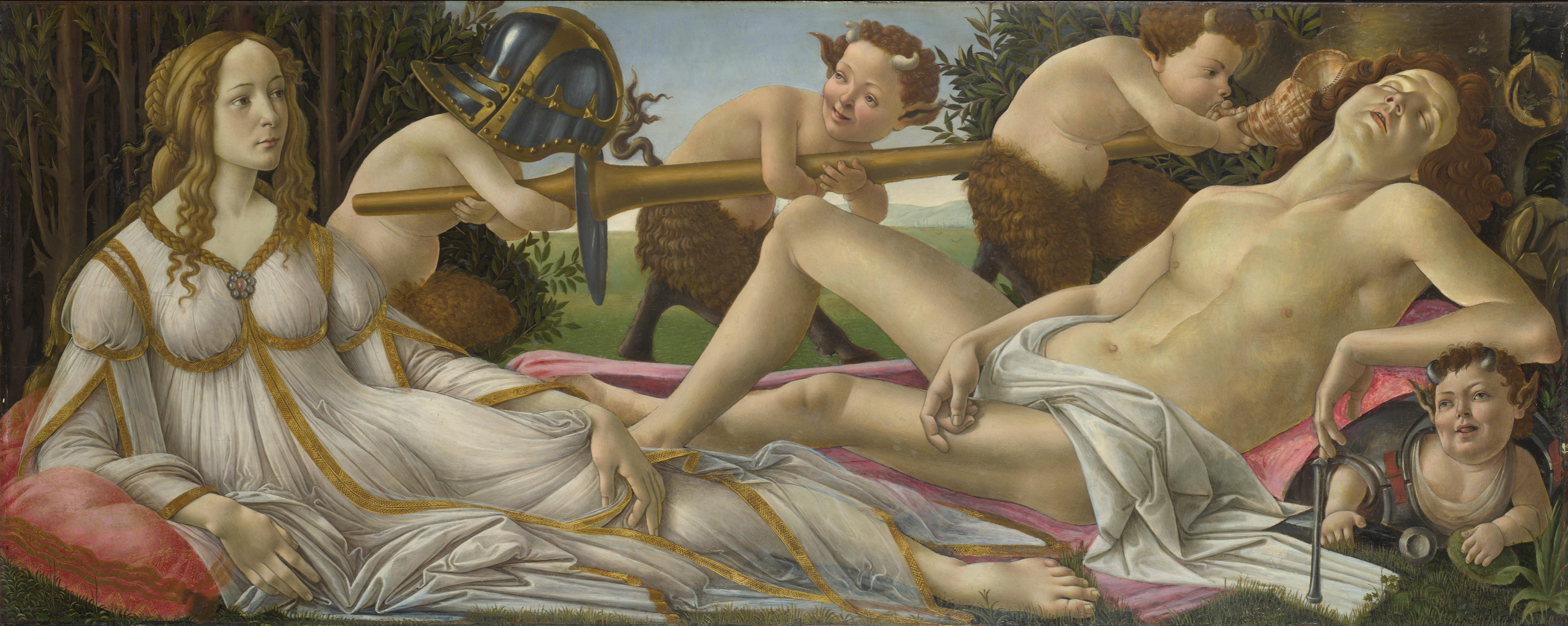
The depictions of these figures and myths also are seen in Roman art. They all have traits and depictions specific to them. Some notable works include Bacchus by Caravaggio, Venus and Mars by Sandro Botticelli, and Venus de Milo. There are so many more myths and gods!


Citation:
Burn, Lucilla. Greek Myths. 6th ed., Austin, U of Texas P, 2002.
A ziggurat is a platform structure to hold a temple with its origins in ancient Mesopotamia. These structures are often compared to cut off pyramids with sloping sides. In most case, ziggurats had small shrines at the top. The most famous example is The White Temple and Ziggurat.
A triptych is a Greek word meaning "three-fold". In art, a triptych is a series of three separate panels, usually hinged together. For a work to be a triptych, it must 1) have three, obvious parts and 2) have a progression of plot or the story must develop across the panels. The idea of a triptych was born in the Christian Middle Ages and was continued!
Used in both art analysis and art creation, the rule of thirds is a method used to keep art interesting to the audience. It states that the main subject that the eye is drawn to should not be in the middle square, were the canvas/ photograph to be split in 3x3 fashion.
Installation art is famously large and quite confusing to many art viewers. It is defined as immersive, large, and specially designed art for the site. In almost all installation art, there is an interactive piece where the viewer can truly experience the art, whether that is walking on/through it, touching it, etc. Above is an example, the Spiral Jetty. During most seasons, the audience can walk on the stone path, but during some times of the year, it is mostly under the water.
What do you think of Installation art? Comment below!!!
Trompe l'oeil or "trick the eye" in French is an art term that does exactly that. Through trompe l'oeil, an artist can play with perspective, create deceiving texture, or further trick their audience. For example, the above, Triumph of the Name of Jesus, is a ceiling painting. The artist uses trompe l'oeil to bring this biblical scene alive.
The Medici family of Florence funded and commissioned a large part of the Renaissance art created. The father, Giovanni di Bocci de' Medici, was a banker and made the family wealthy. The Medici family employed Sandro Botticelli, famous Italian Renaissance painter. They were in fact the wealthiest family of the 15th century, due to their starting the largest bank in Florence.
Many people do not realize while viewing works of art that lots of effort goes into the display, design, timing, lighting, and sequence of these exhibitions in art galleries and museums.
Curation is the act of staging and designing the environment and flow of an exhibition within the space given. In the art world, a curator's job is to create the ideal path of travel and thought throughout an art exhibition. Many people who pursue art history degrees go on to become curators. The architect of the building also contributes to these decisions, but the curator has to work within the parameters of the space. The next time you visit an art gallery, ponder what went into into it. I encourage you to think about the decisions the curator made.
Do you have a favorite gallery? Comment below!
Local and non-local color are both used in art, but they are used by artists for very different reasons.
Local color is when an artist uses natural and true-to-life color to depict their subject matter. For example, the two works above are by firstly Paul Cezanne and secondly Mary Cassatt. Cezanne uses local color to depict this landscape. Color-wise, he paints this image for the audience in the way it would be seen were the viewer to actually be there. He does use irregular brushstroke (click
HERE to learn more about that form of expression).
Mary Cassatt (click on the name to learn more about her as an artist and this work) uses local color once more in this portrait.
Non-local color is used by an artist to convey a message. Non-local color is color that is used, but in real life, the subject matter would not appear this way. For example, above Andy Warhol uses non-local color in this screen-print portrait of Marylin Monroe.
The canon of proportions is the calculation of the proportions of a human being.
Many civilizations used these in their sculpture to make the human figure look as ideal as possible. Ancient Egyptian, Archaic, Hellenistic, and many more civilizations applied the canon of proportions to their art. For example, most artists had graphs and drawings of their proportions before beginning a work.
Contrapposto is a common pose used in these types of sculptures also.
Most commonly the figure is one of power, as shown above, Augustus of Primaporta, and has one weight-baring leg and the other is relaxed. Contrapposto was very common among Ancient Egyptian, Archaic, Hellenistic, and many more civilizations' sculpture.
A reliquary is a collection of holy objects and is used for personal worshiping.
Most famously used and produced in the Renaissance and Medieval times, reliquaries were not only useful in religious practice, but were also a big art form of the time. A reliquary consists of small sculptures or engravings of saints or gods and other small objects that could be used for worship. The majority of reliquaries were Catholic, but a small number were actually Buddhist.
Caravaggio (click the name to read more about him) was a trailblazer in the Italian Baroque. He was a painter who used tenebrism and lead the Baroque movement to its height.
Caravaggio was very protective of his artistic style throughout his life. He even went so far as to threaten painters that he believed were copying (Caravaggio was know as a hot head). However after his death in 1610, a group of many artists came to be known as his followers. While none of these artists met or worked with Caravaggio, this group of followers became known as the Caravaggisti. One example is Artemisia Gentileschi.
Comment a term you would like to learn more about!!
While somewhat a self-explanatory term, brushstroke is an important factor in identifying and analyzing art.
The meaning of brushstroke in art goes beyond just the simple meaning of the word. Take a close look into this Van Gogh work. Zoom into this high resolution image. Not only does it enhance the rendering of the the image, but it makes a statement. Prominent brushstrokes are very common in Post-Impressionism.
In this work, the brushstrokes are not supposed to be a statement nor are they supposed to be noticed. The brushstroke is just a vehicle for the realism that Hopper chooses to use.
The term "foreshortening" refers to a subject or object in a piece of art that is placed close to the viewer and recedes. This creates a shortened perspective. For example, Christ, the main figure, above, is positioned in a way that makes Christ look very short, yet it gives the figure dimension. Above is the most popular example of foreshortening.
The art term "Momentum Mori" has been used for many years and is used to describe reminders of death in art.
Saint Jerome Writing by Michelangelo Merisi da Caravaggio is a classic example of momentum mori. Directly translating to "remember you will die" or "remember death", momentum mori are reminders of mortality through art. In this work, Caravaggio uses tenebrism (click the word to learn more about this art term) to highlight the skull, his choice of momentum mori, in this work.
The skull is the most popular choice of momentum mori in art, for it is the most obvious.
At first glance, this work seems to be absolutely free of momentum mori. It is light, free, and full of life through the fruit in the still life. As with many works, the longer the eyes linger upon the canvas, the more of an eerie feeling seems to radiate from the painting. In this work, some fruits are thriving, such as the grapes, which are a symbol of Christ, but many others have been badly battered and bruised. The momentum mori in this painting come into play with the harmed fruits, the flies, and the lizards. At the very top of the canvas, the viewer finds flies, and at the bottom lizards, both of which are considered signs of evil. While at first glance this might seem like a normal still life, the momentum mori in this painting are just as strong as that of the above paintings.
This mix up can be quite confusing, but is any art aficionado's nightmare. While it is a very easy and common mistake to make, it is also an easy fix. So here we go.
Did this help? Are there any other terms you think I should do? Let me know, and leave a comment!
Though it is a simple term, media is use almost constantly and is crucial to understanding art writing today. Media, the plural of medium, simply means the material used to create the specific piece of art in question. For example, in the
post about Italian Baroque, it says, " During the Italian Baroque, prominent artists worked in many
media including sculpture, painting, and architecture." I am saying that there was lots of art produced with all different materials.
If something mentions or explains the facade of a building, they are referring to the face of this architecture. Most of the time it is the main place of entry or sometimes the part of the building that faces the street. Above is the facade of
San Carlo alle Quattro Fontane, a baroque building (click the name to see the description). While facade is a fairly simple term, I feel it is important to understand the meaning, because it is used a lot when describing architecture. Below are some more examples.